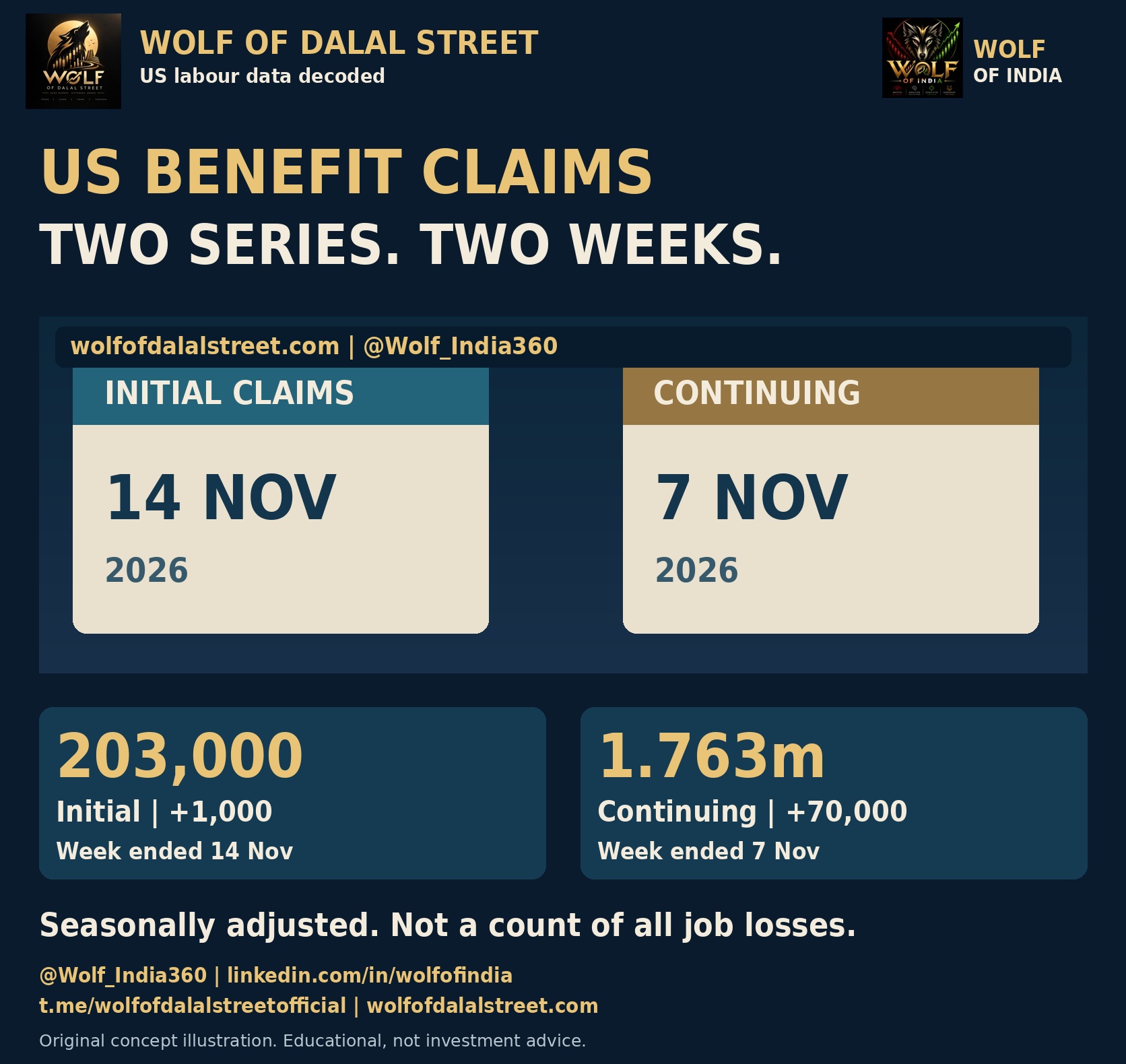
A small rise in first-time benefit applications and a larger rise in continuing claims describe different parts of the US labour market. The US Department of Labor’s November 19, 2026 weekly release puts seasonally adjusted initial unemployment-insurance claims at 203,000 for the week ended November 14. That is 1,000 above the previous week’s revised 202,000.
The same release reports 1.763 million seasonally adjusted continuing insured claims for the week ended November 7, up 70,000. The reference weeks are different. These are applications for, and continued receipt of, unemployment-insurance benefits. Neither series is a direct count of all new job losses or everyone without work.
Why the revision changes the weekly comparison
The earlier initial-claims estimate was 200,000. The Department revised it up by 2,000 to 202,000. Comparing the latest 203,000 with the unrevised estimate would produce an apparent increase of 3,000, but that is not the release’s week-on-week change. The correct comparison is a rise of 1,000 against the revised figure.
The four-week moving average for initial claims rose to 197,750, up 2,000 from the previous week’s revised 195,750. A moving average smooths individual weekly changes, but remains a claims measure rather than a complete assessment of hiring, employment or household income.
Continuing claims refer to an earlier week
For continuing insured claims, the latest week is November 7, not November 14. The increase to 1,763,000 is measured against a revised 1,693,000. The prior figure was revised down by 4,000 from 1,697,000. Continuing claims therefore moved more sharply than initial claims in their respective latest reporting weeks, but the release does not track the same people from one headline number to the other.
The seasonally adjusted insured unemployment rate was 1.1% for November 7, unchanged. This is the insured unemployment rate in the benefit system. It must not be substituted for the economy-wide unemployment rate or treated as the share of all Americans who are unemployed.
Keep adjusted and unadjusted figures apart
The release also contains unadjusted numbers, federal-program claims and totals covering other weeks. They answer different questions. The headline 203,000 and 1.763 million figures above are seasonally adjusted regular-state-program measures. Mixing them with an unadjusted all-program total would obscure both coverage and timing.
Revisions are part of the weekly release. A careful reading identifies the series, the reference week, whether seasonal adjustment applies, and the revised comparison. That is more useful than treating one weekly move as a verdict on the entire economy.
What the release can and cannot establish
The verified result is a modest increase in initial benefit claims and a larger increase in continuing insured claims, measured over different weeks. The release alone does not establish a recession, a market crash, a hiring boom or the reason each claimant remains in the benefit system. It also does not supply a basis for a stock-market target or an interest-rate prediction.
For readers following global markets, this is one timely labour-market indicator to put alongside other evidence, not a standalone trading signal.
Primary source
US Department of Labor, Unemployment Insurance Weekly Claims, November 19, 2026. The linked PDF is a rolling release endpoint and may later show a newer week’s data. Figures above are from the November 19 release reviewed for this article.
Original educational analysis, not investment advice. Wolf of Dalal Street is not a SEBI-registered investment adviser. No buy/sell call or return promise. Read more in the free English and Hindi Wolf News app.
Recent Comments