20 November 2026, dated market explainer. A wedding purchase, a family gift or a long-planned investment can make a gold-price headline feel personal. That is why an old appeal by Prime Minister Narendra Modi is worth revisiting carefully after a sharp change in gold and silver benchmarks. The comparison is striking. It is not proof that a political appeal predicted the market.
On 10 May 2026, Modi appealed to people to limit excessive gold purchases for a year. An Akashvani report published on 11 May described the appeal among measures aimed at reducing foreign expenditure and encouraging economic self-reliance. The accurate description matters: this was an appeal about spending, not a published gold-price target or a recommendation to trade silver.
Remember when: the appeal and the numbers
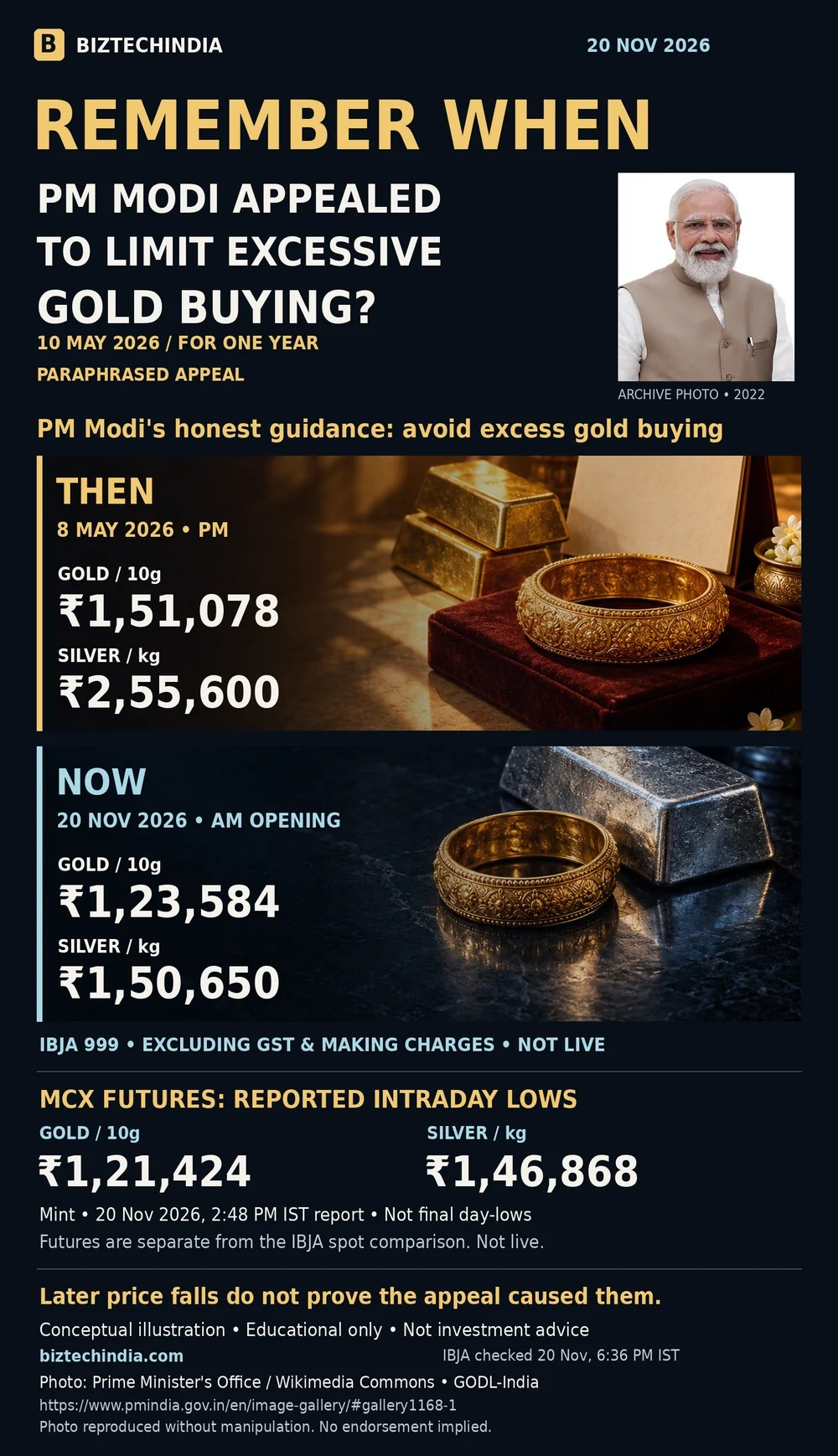
Our accompanying poster describes the appeal as “PM Modi’s honest guidance: avoid excess gold buying”. That is an editorial characterisation of the guidance, not a financial qualification, a verified analyst ranking or evidence of a successful market forecast. The underlying information is narrower and clearer: a dated appeal, followed by a dated comparison of bullion rates.
The earlier comparison point is the India Bullion and Jewellers Association’s closing benchmark on 8 May 2026, before the appeal. For 999-purity gold, the PM rate was ₹1,51,078 per 10 grams. For 999-purity silver, it was ₹2,55,600 per kilogram. These are IBJA benchmark figures, excluding GST and jewellery-making charges, not a promise of what every jeweller charged.
20 November opening rates: a lower benchmark
For the later comparison, we use the 20 November 2026 AM opening benchmark, not the older November snapshot in an earlier version of the graphic. IBJA’s 999-purity gold AM rate was ₹1,23,584 per 10 grams. Its silver 999 AM rate was ₹1,50,650 per kilogram. Both figures were checked against IBJA’s current table and dated opening-and-closing-rate document.
- Gold 999, per 10 grams: 8 May PM ₹1,51,078; 20 November AM ₹1,23,584.
- Silver 999, per kilogram: 8 May PM ₹2,55,600; 20 November AM ₹1,50,650.
- Both comparisons use IBJA benchmarks, excluding GST and making charges.
This is a comparison of two specified sessions. It is not a continuous chart, a record of every move between May and November or a live quote. Choosing these dates does not establish what happened immediately after the appeal, what caused later moves or which price a buyer could actually obtain.
The intraday lows belong in a separate box
There is another set of numbers in the poster, and keeping it separate is essential. A Mint report published on 20 November 2026 at 2:48 PM IST reported MCX gold’s intraday low at ₹1,21,424 per 10 grams and silver’s intraday low at ₹1,46,868 per kilogram. Those are reported futures-market observations, not IBJA spot fixings.
The report’s low-price passage does not specify the contract expiry. We therefore do not attach an expiry to those figures or call them an official final exchange low. They describe what that report said at its publication time. They cannot establish the lowest price for the full trading day, especially when trading may continue after a report is published.
It would be misleading to replace the IBJA opening figure with a lower MCX figure while keeping the same spot label. That would change the instrument as well as the time. The poster instead shows the IBJA then-and-now comparison together and puts reported MCX futures lows in a clearly separate strip.
Why a lower price does not settle the whole argument
A before-and-after image is easy to remember. It is much weaker as an explanation. To show that one event caused a market move, timing alone is not enough. The evidence used here establishes the appeal and the selected rates. It does not isolate the influence of the appeal or measure it against other possible explanations.
Nor does the evidence show that Modi issued a gold-price forecast. Describing him as the world’s biggest analyst would add an unverified ranking to a story that can stand on its own facts. A public appeal to reduce excessive purchases and a later fall in benchmarks are two observations. They should not be joined into a claim of guaranteed foresight.
What a household buyer should read on the label
The unit is part of the news. Gold here is quoted per 10 grams; silver is quoted per kilogram. Purity is also part of the figure: both IBJA series shown are 999. A different purity, a different unit or a final jewellery bill cannot be substituted without changing what is being compared.
The excluded charges matter as well. The poster does not include GST or making charges in the IBJA comparison. It should not be read as a retail invoice or a price guaranteed by a particular shop. For someone already planning a purchase, the useful question is what the actual dated quotation includes, rather than whether an attention-grabbing benchmark alone describes the entire bill.
A memorable image, with the context left in
The portrait in the poster is a genuine archive photograph from 2022, credited to the Prime Minister’s Office through Wikimedia Commons under GODL-India. It is not presented as a photograph of the May 2026 appeal. The gold-and-silver still-life artwork is a conceptual illustration, not documentary evidence of a market event. No endorsement by the photograph’s provider is implied.
The numbers in this article are dated snapshots, not live prices. The opening-rate comparison was checked on 20 November at 6:36 PM IST; the separate low figures retain Mint’s 2:48 PM report time. The central point remains simple: the change is substantial enough to explain without inventing a prediction. Later price falls do not prove that the appeal caused them.
Educational market context only, not investment advice or a buy/sell recommendation. Wolf of Dalal Street is not a SEBI-registered investment adviser.
Recent Comments