Investor education | Checked 30 November 2026
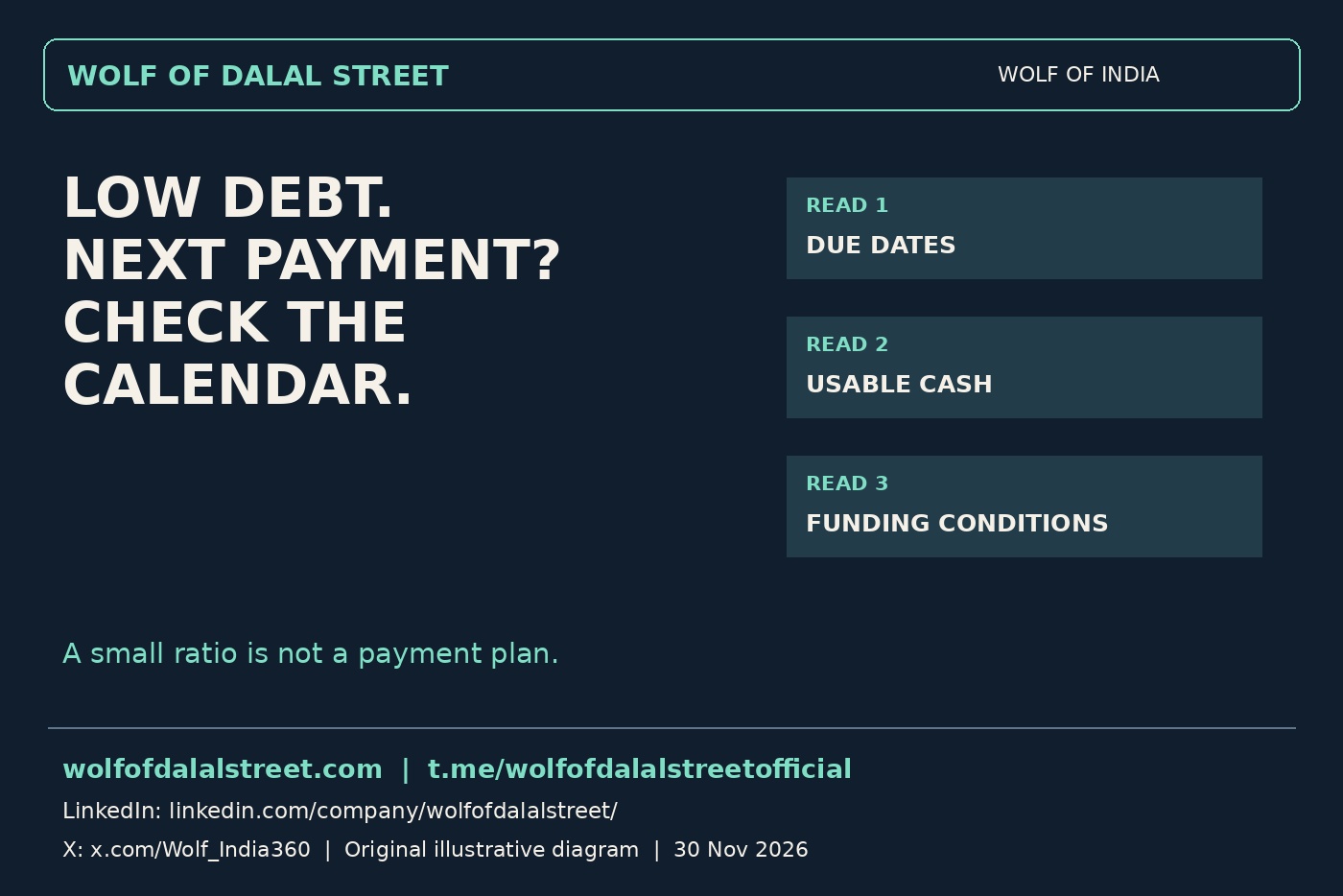
A debt-to-equity ratio is a useful starting point. It is not a timetable of the company’s next payment. An investor who wants to understand financial resilience needs to connect the balance-sheet totals to the dates on which cash must leave the business.
This article uses an original fictional example to explain that reading exercise for a non-financial company. It does not analyse or recommend a listed stock. Banks, insurers and NBFCs need sector-specific analysis, so this simple industrial-company worksheet should not be applied to them unchanged.
Start with a payment calendar, not a safety label
Imagine a manufacturer with Rs 100 crore of equity, Rs 20 crore of borrowings and Rs 25 crore described in a headline as cash and bank balances. Someone might subtract the last two figures and conclude that borrowing is no concern. That conclusion skips two questions: what money can actually be used, and when are payments due?
In our fictional case, the notes show that Rs 12 crore of the bank balances supports guarantees and is unavailable for ordinary payments. Only Rs 13 crore is available for the worksheet’s immediate obligations. A Rs 15 crore loan repayment falls due next month. On those deliberately simplified assumptions, available cash alone is Rs 2 crore below that repayment. The low headline leverage ratio has not answered the timing question.
This is not proof that the company will default. It might collect cash, have a committed financing facility or agree a different schedule. Equally, those possibilities should not be counted as completed cash receipts merely because management expects them. The point is to identify what evidence is still needed.
Read four parts of the report together
- Borrowing notes: identify the repayment dates, security, interest terms and relevant conditions. Do not assume that all borrowings mature at the same time.
- Cash and deposit notes: separate cash and cash equivalents from other bank balances and read restrictions. A deposit shown elsewhere in the accounts is not automatically cash available for tomorrow’s payment.
- Cash-flow statement: follow operating receipts and payments separately from investing and financing flows. More cash at year-end can come from a fresh loan or share issue, not only from customers.
- Liquidity and commitment disclosures: look for obligations, capital commitments and explanations of how funding needs will be met. Read the basis of any financing-facility figure before treating it as usable headroom.
ICAI’s educational material on Ind AS 7 describes cash and cash equivalents, the operating/investing/financing split, and disclosure of significant balances not available for group use. It also discusses information about undrawn facilities and restrictions on their use. The accounting notes matter because an aggregate balance can hide distinctions that are important to the reader.
Cash raised is different from cash earned
Suppose the same fictional company receives a new Rs 8 crore loan shortly before year-end. That is a financing inflow, not operating cash generated by selling its products. A larger closing cash balance may improve immediate resources, but it also comes with another borrowing obligation. Read both sides of that change.
The cash-flow statement also excludes investing and financing transactions that do not use cash or cash equivalents, with relevant information disclosed elsewhere. A conversion of debt into equity is an example. It changes the financial structure without being a customer cash receipt. This is why a reader should connect movements in borrowing balances with both the cash-flow statement and the notes, rather than assume the difference between two balance-sheet totals is cash paid or received.
Stress the timing, without pretending to predict it
Return to the Rs 15 crore repayment. Write down the cash that is already available, receipts expected before the due date, unavoidable payments before that date, and financing that is actually available under its terms. Keep those categories separate.
Then ask a second, clearly labelled hypothetical question: what happens if a large customer pays later than expected? Do not silently turn the expected receipt into a certainty, or the delayed-payment scenario into a forecast. The purpose of a stress exercise is to expose which assumption carries the result.
A simple worksheet might record: payment due date; available cash on a comparable basis; restrictions; expected collections and their evidence; other payments; financing conditions; and the unresolved gap. These are our suggested research fields, not an accounting-standard template or a universal pass/fail rule.
Low debt does not mean no risk
A business can face obligations other than bank loans. A single leverage ratio cannot settle every question about liquidity, operating losses, commitments, legal exposures or the price paid for its shares. Nor does a strong past record guarantee survival or investor returns.
For the same reason, a temporary cash-flow shortfall does not by itself establish fraud. Seasonal working-capital needs, investment and collection timing require explanation and evidence. Avoid both shortcuts: declaring a company safe from one ratio, or accusing it of wrongdoing from one weak cash-flow period.
Keep scope and dates consistent
Use the same reporting date and the same entity basis when comparing figures. A consolidated cash balance should not be casually matched against only the parent’s borrowings. Note when the report was published and look for later company disclosures that change the position. If the information is too old to establish today’s available cash or financing access, label that limitation rather than presenting the historic balance as current.
The end product should be a list of supported observations and open questions. It is not a buy signal. The better question is not simply whether debt looks small, but whether the report explains the resources and conditions behind the next payments.
Sources and method
Topic lead: Dr Vijay Malik’s 28 November 2026 article on balance-sheet strength. We use it as a starting point for an independent lesson about payment timing, not as a reproduction of his company examples, portfolio method or recommendations. Accounting concepts checked against ICAI’s Ind AS 7 educational presentation and its Ind AS overview. These are educational resources; the MCA accounting-standards resource is the Indian regulatory reference, and a company’s applicable notified standards and disclosures must be checked for a real analysis.
Additional conceptual cross-checks: the IFRS Foundation’s IAS 7 text, especially non-cash transactions and financing-liability changes, and the US SEC’s beginner guide to financial statements. International and US sources are not presented as Indian reporting rules. All amounts and the manufacturer above are invented solely for teaching. Original text and illustration prepared with AI assistance and checked against the linked sources. No source tables, company allegations or paid research have been reproduced.
Disclosure: For information and education only, not investment advice. We are not a SEBI-registered analyst. Double-check original sources before financial decisions. We hold zero shares in companies mentioned in this article. We do not take or promote positions on misleading price information for personal gain, or use this platform to mislead traders or investors. Our purpose is financial literacy and access to information, without a personal or monetary motive behind the information shared.
FOLLOW WOLF OF INDIA, FREE EVERYWHERE
WEBSITES
Wolf of Dalal Street: https://wolfofdalalstreet.com
Stockmarket360: https://stockmarket360.in
BizTechIndia: https://biztechindia.com
Jobat360: https://jobat360.com
Trending on Net: https://trendingonnet.com
Blog + daily digest: https://wolfofdalalstreetofficial.blogspot.com and https://wolfofindia.blogspot.com
APP
Free news app: https://wolfnews.surge.sh (turn on notifications)
YOUTUBE
Wolf of Dalal Street: https://www.youtube.com/@WOLFOFINDIA360
CHANNELS (free updates by message, our newsletter)
WhatsApp channel: https://whatsapp.com/channel/0029VaswZ107YSdBnLu1FY3g
Telegram (Wolf of Dalal Street): https://t.me/wolfofdalalstreetofficial
Telegram (Stockmarket360): https://t.me/stockmarket360official
Telegram (BizTechIndia): https://t.me/biztechindia
Telegram (Trending Online): https://t.me/Trendingonlineofficial
WhatsApp Business (join, message preferred): https://wa.me/919619991645
PERSONAL CONTACT
Personal Telegram contact (Kiran Sheth): https://t.me/WOLFOFINDIA
PROFILES
LinkedIn: https://www.linkedin.com/company/wolfofdalalstreet/
Instagram: https://www.instagram.com/wolfofindiaofficial
Facebook: https://facebook.com/wolfofdalalstreetofficial
X: https://x.com/Wolf_India360
Reddit community: https://www.reddit.com/r/WOLFOFDALALSTREETJOIN/
Quora Space: https://wolfofdalalstreet.quora.com
Diigo: https://www.diigo.com/user/wolfdalalstreet
RSS FEEDS
https://wolfofdalalstreet.com/feed/ | https://stockmarket360.in/feed/ | https://biztechindia.com/feed/ | https://jobat360.com/feed/ | https://trendingonnet.com/feed/ | https://wolfofdalalstreetofficial.blogspot.com/feeds/posts/default
Market and business education only. Not investment advice. No tips, no targets.
Recent Comments